


Ordinary Time: May 28th
Thursday of the Eighth Week in Ordinary Time
Other Commemorations: St. Germanus, Bishop (RM); Bl. Margaret Pole, Mother and Martyr (RM); Feast of Our Lord Jesus Christ, the Eternal High Priest (particular calendars)
MASS READINGS
May 28, 2026 (Readings on USCCB website)
PROPERS [Show]
COLLECT PRAYER
Eighth Week in Ordinary Time: Grant us, O Lord, we pray, that the course of our world may be directed by your peaceful rule and that your Church may rejoice, untroubled in her devotion. Through our Lord Jesus Christ, your Son, who lives and reigns with you in the unity of the Holy Spirit, God, for ever and ever.
Recipes (0)
Activities (7)
Prayers (2)
Library (5)
Blog & Podcasts (0)
On the first Thursday after Pentecost, the Feast of Our Lord Jesus Christ, the Eternal High Priest is observed on the particular calendars in Spain, Poland, Netherlands, Czech Republic and England and Wales. Approval for this feast was first granted by the Congregation for Divine Worship and the Discipline of the Sacraments in 1987. In 2012 the Congregation sent a letter to all conferences of bishops, offering the feast to be inscribed in their respective liturgical calendars if they request it.
The Roman Martyrology commemorates St. Germanus of Paris (496-576), Bishop of Paris in 555. He was renowned for his miracles which were recorded by Bishop Fortunatus.
Bl. Margaret Pole (1473-1541) is also commemorated. She was born Margaret Plantagenet, the niece of Edward IV and Richard III. She married Sir Reginald Pole about 1491 and bore five sons, including Reginald Cardinal Pole. Margaret was widowed, named countess of Salisbury, and appointed governess to Princess Mary, daughter of Henry VIII and Queen Catherine of Aragon, Spain. She opposed Henry's marriage to Anne Boleyn, and the king exiled her from the court, although he called her "the holiest woman in England." When her son, Cardinal Pole, denied Henry's Act of Supremacy, the king imprisoned Margaret in the Tower of London for two years and then beheaded her on May 28. In 1538, her other two sons were executed. She was never given a legal trial. She was seventy when she was martyred. Margaret was beatified in 1886.

Thursday after Pentecost
Station with San Lorenzo in Panisperna (St. Lawrence in Panisperna):
Let us not forget that we celebrate today's mysteries "with St. Lawrence," the Roman deacon who walked so perfectly in the footprints of his predecessor in the diaconate, St. Philip. The unclean are cleaned, the sick are healed and joy reigns supreme. Pentecostal cleansing, pentecostal healing, pentecostal joy! Let us be modern Philips and Lawrences helping to alleviate bodily and spiritual misery of our brethren, thus paving the way for the "Spirit of the Lord who fillet the whole world." (Msgr. Martin Hellriegel)
The church stands on the site of St. Lawrence's martyrdom. The appellation refers to the name of the street, which in turn most likely refers to the tradition of the Poor Clares in the adjacent convent of distributing bread and ham (pane e perna) on August 10th, the feast day of St. Lawrence. This is done in remembrance of St. Lawrence distributing funds from the church to the poor.
For more on San Lorenzo in Panisperna, see:
For further information on the Station Churches, see The Stational Church.
Feast of Our Lord Jesus Christ, the Eternal High Priest
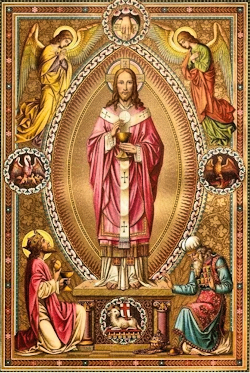 The feast focuses firstly on Jesus’ Priestly Office (Latin: Munus sacerdotale). He is considered the model for believers, and for the clergy in particular, with priests acting In persona Christi (“In the person of Christ”). The laity are thus urged to pray that priests would be more like Christ, the compassionate and trustworthy high priest (Hebrews 2:17), ever-living to intercede for humanity before The Father (Heb 7:25).
The Second Vatican Council taught many things about the Priesthood of Christ, and sharing in that one Priesthood through the Sacraments of Baptism and Holy Orders. This development has been reflected in many subsequent documents. One effective way to build upon this teaching is to establish the Feast of Christ the Priest more widely.
What Pope Pius XI wrote about the feast in honor of Christ’s Kingly Office can be said just as truly about this feast in honor of Our Lord’s Priesthood:
For people are instructed in the truths of faith, and brought to appreciate the inner joys of religion far more effectually by the annual celebration of our sacred mysteries than by any official pronouncement of the teaching of the Church. Such pronouncements usually reach only a few and the more learned among the faithful; feasts reach them all; the former speak but once, the latter speak every year - in fact, forever.[8]
The entry from the Roman Martyrology (2005) reads:
Thursday after Pentecost: The Feast of Our Lord Jesus Christ, The Eternal High Priest, according to the order of Melchizedek. In him the Father has been well pleased from before all time. As Mediator between God and human beings, fulfilling his Father’s will, he sacrificed himself once on the altar of the Cross as a saving Victim for the whole world. Thus, instituting the pattern of an everlasting sacrifice, with a brother’s kindness he chose, from among the children of Adam, men to augment the priesthood, so that, from the sacrifice continually renewed in the Church, streams of divine power might flow, whereby a new heaven and a new earth might be made, and throughout the whole universe there would be perfected what no eye has seen, nor ear heard, nor has entered into the human heart.
St. Germanus
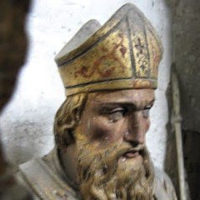 St. Germanus, the glory of the Church of France in the sixth century, was born in the territory of Autun, about the year 496. In his youth he was conspicuous for his fervor. Being ordained priest, he was made abbot of St. Symphorian's; he was favored at that time with the gifts of miracles and prophecy. It was his custom to watch the great part of the night in the church in prayer, whilst his monks slept.
One night, in a dream, he thought a venerable old man presented him with the keys of the city of Paris, and said to him that God committed to his care the inhabitants of that city, that he should save them from perishing.
Four years after this divine admonition, in 554, happening to be at Paris when that see became vacant on the demise of the Bishop Eusebius, he was exalted to the episcopal chair, though he endeavored by many tears to decline the charge. His promotion made no alteration in his mode of life. The same simplicity and frugality appeared in his dress, table, and furniture. His house was perpetually crowded with the poor and the afflicted, and he had always many beggars at his own table. God gave to his sermons a wonderful influence over the minds of all ranks of people; so that the face of the whole city was in a very short time quite changed.
King Childebert, who till then had been an ambitious, worldly prince, was entirely converted by the sweetness and the powerful discourses of the Saint, and founded many religious institutions, and sent large sums of money to the good bishop, to be distributed among the indigent.
In his old age St. Germanus lost nothing of that zeal and activity with which he had filled the great duties of his station in the vigor of his life; nor did the weakness to which his corporal austerities had reduced him make him abate anything in the mortifications of his penitential life, in which he redoubled his fervor as he approached nearer to the end of his course. By his zeal, the remains of idolatry were extirpated in France.
The Saint continued his labors for the conversion of sinners till he was called to receive the reward of them, on the 28th of May, 576, being eighty years old.
—Excerpted from The Daily Gospel
Highlights and Things to Do:
- Read more about St. Germanus:
- Read about the oldest church in Paris, Abbaye de St Germain-des-Près.
Bl. Margaret Pole
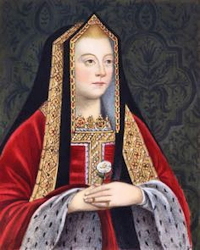 Margaret was born into the ruling dynasty in 1473, at Farleigh Hungerford, in Somerset. Her father, the Duke of Clarence, was brother to both Edward IV and Richard III. This meant that all her life she was seen as a threat to the ruling monarchs, as she had a legitimate claim to the throne and was therefore a potential figurehead in any revolt against the crown. Indeed as soon as the Tudors came to power they imprisoned Margaret's brother, the Earl of Warwick, and eventually executed him.
The Tudors sought to defuse her potential threat by keeping her close to them, marrying her to Sir Richard Pole, who was related to Henry VII, and keeping her close at court. Margaret became lady in waiting to Catherine of Aragon, beginning a lifelong friendship, and she became governess to Princess Mary, the daughter of Henry VIII and Catherine.
At first Henry favoured Margaret, restoring to her lost family lands and titles, but this came to an end at the time of his divorce from Catherine. Her loyalty to Catherine, and to Mary, as well as to her Catholic faith, brought her into conflict with the King at the time of his divorce and remarriage to Anne Boleyn. If her own opposition to Henry’s behaviour, and her position as a possible contender for the throne when the Tudor dynasty was looking shaky were not enough, her son Reginald Pole was needling the King from overseas and encouraging opposition to him. This made Margaret’s position very dangerous indeed.
Although the King described her as ‘the holiest woman in England’ she was arrested on the grounds of treason, and imprisoned for some time at Cowdray in 1538-9, although she never faced trial and there was no credible evidence against her. In spite of this she was executed in 1541, at the age of 70. Reportedly the inexperienced executioner took ten blows to sever her head.
When her son Reginald Pole, now a cardinal, heard of his mother's death, he is reported to have said: "Hitherto I have thought myself indebted to the divine goodness for having received my birth from one of the most noble and virtuous women in England; but from henceforth my obligation will be much greater, for I understand that I am now the son of a martyr. May God be thanked and praised. We must rejoice, because now we have one more patron to intercede for us in Heaven."
Margaret Pole was beatified with other martyrs of penal times in 1886.
Highlights and Things to Do:
- Read more about Bl. Margaret:
