Ordinary Time: May 27th
Wednesday of the Eighth Week in Ordinary Time; Opt Mem of St. Augustine of Canterbury, Bishop; Ember Wednesday
MASS READINGS
May 27, 2026 (Readings on USCCB website)
PROPERS [Show]
COLLECT PRAYER
Eighth Week in Ordinary Time: Grant us, O Lord, we pray, that the course of our world may be directed by your peaceful rule and that your Church may rejoice, untroubled in her devotion. Through our Lord Jesus Christ, your Son, who lives and reigns with you in the unity of the Holy Spirit, God, for ever and ever.
Optional Memorial of St. Augustine of Canterbury: O God, who by the preaching of the Bishop Saint Augustine of Canterbury led the English peoples to the Gospel, grant, we pray, that the fruits of his labors may remain ever abundant in your Church. Through our Lord Jesus Christ, your Son, who lives and reigns with you in the unity of the Holy Spirit, God, for ever and ever.
Recipes (3)
Activities (9)
Prayers (4)
Library (2)
Blog & Podcasts (5)
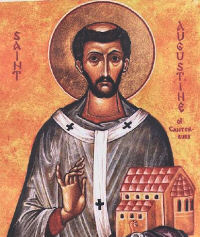
Today is the Optional Memorial of St. Augustine of Canterbury (d. 605), who was born in Rome and died in Canterbury, England, in 604. When Pope Gregory I heard that the pagans of Britain were disposed to accept the Catholic Faith, he sent the prior of St. Andrew, Augustine, and forty of his Benedictine brethren to England. Despite the great difficulties involved in the task assigned to him, Augustine and his monks obeyed. The success of their preaching was immediate. King Ethelbert was baptized on Pentecost Sunday, 596, and the greater part of the nobles and people soon followed his example. St. Augustine died as the first Archbishop of Canterbury.
It is traditionally Ember Wednesday of the Summer or Pentecost Embertide. These Ember Days fall during the week after Pentecost (the traditional octave of Pentecost), near the summer solstice. The three focal points for the Ember Days of this period of the year are: 1) to ask God to bless especially the wheat harvest, 2) to thank God for the season of summer, and 3) to ask for special graces for those being ordained as priests during this season.
Pentecost Ember Days
Originally the summer Ember Days served as a time of thanksgiving at the end of the wheat harvest in Mediterranean countries. The present liturgy (pre-Vatican II), only faintly suggests or alludes to harvest time; rather, wheat and harvest time are used as symbols of supernatural realities. For us wheat is the Eucharistic "Bread of Life", and the harvest is the that of souls reaped by the Holy Ghost. "The floors shall be filled with wheat, and the presses shall be filled with wheat, and the presses shall be filled with oil and wine (Lesson for Ember Friday).
Ember week is a recognized time for spiritual renewal, an occasion to review the past as well as to scan the future. And during these days after Pentecost we can sense more easily the original import and the spirit of joyous gratitude proper to Ember week. Gratitude, not penance, should be the dominant Ember spirit. Even fasting can be an act of thanksgiving! Let us stress positive rather than negative values in our Christian life, cultivate the consciousness of being God's holy children rather than feel ourselves as outcasts and sinners.
Wednesday of Ember week is dedicated to Mary, it is a day of interior recollection. Friday is devoted to penance, while Saturday lays greatest stress on thanksgiving. Make a summary review today of the past quarter year. These three months, covering the Lenten and Paschal seasons, were certainly the most important segment of the Church's year of grace. What tremendous graces we received! But how did we use them? Are they producing fruit? Will there be a spiritual harvest?
—Excerpted from The Church's Year of Grace by Pius Parsch
See Summer or Pentecost Ember Days and Contemporary Observation of Ember Days for more information.
Ember Wednesday after Pentecost
Station with Santa Maria Maggiore (St. Mary Major):
Perseverance in prayer, unity of mind and heart and "station" with Mary, the Mother of Jesus and our Mother, such must be the dispositions in our heart if the mysteries of this Ember Wednesday are to bear fruits for eternity. May the pure spouse of the Holy Spirit, the golden lamp on which burnt the brightest pentecostal flame pray for us, that the Spirit of the Lord may fill our hearts, and enkindle them with the fire of His love. (Msgr. Martin Hellriegel)
For more on Santa Maria Maggiore, see:
For further information on the Station Churches, see The Stational Church.
St. Augustine of Canterbury
 St. Augustine was the agent of a greater man than himself, Pope St. Gregory the Great. In Gregory's time, except for the Irish monks, missionary activity was unknown in the western Church, and it is Gregory's glory to have revived it. He decided to begin with a mission to the pagan English, for they had cut off the Christian Celts from the rest of Christendom. The time was favorable for a mission since the ruler of the whole of southern England, Ethelbert/ of Kent, had married a Christian wife and had received a Gaulish bishop at his court. Gregory himself wished to come to Britain, but his election as pope put an end to any such idea, and in 596 he decided to send an Italian monk following the comparatively new Rule of St Benedict. Augustine set out with some companions, but when they reached southern Gaul a crisis occurred and Augustine was sent back to the pope for help. In reply the pope made Augustine their abbot and subjected the rest of the party to him in all things, and with this authority Augustine successfully reached England in 597, landing in Kent on the Isle of Thanet. Ethelbert and the men of Kent refused to accept Christianity at first, although an ancient British church dedicated to St Martin was restored for Augustine's use; but very shortly afterwards Ethelbert was baptized and, the pope having been consulted, a plan was prepared for the removal of the chief see from Canterbury to London and the establishment of another province at York. Events prevented either of these projects from being fulfilled, but the progress of the mission was continuous until Augustine's death, somewhere between 604 and 609.
The only defeat Augustine met with after he came to England was in his attempt to reconcile the Welsh Christians, to persuade them to adopt the Roman custom of reckoning the date of Easter, to correct certain minor irregularities of rite and to submit to his authority. Augustine met the leaders of the Welsh church in conference but he unfavorably impressed them by remaining seated when they came into his presence — it is likely that in this he unfavorably impressed St Bede too. Augustine was neither the most heroic of missionaries, nor the most tactful, but he did a great work, and he was one of the very few men in Gaul or Italy who, at that time, was prepared to give up everything to preach the gospel in a far country.
—Excerpted from The Saints edited by John Coulson
Patronage: England; Canterbury, England; diocese of Salford, England; archdiocese of Southwark, England; Personal Ordinariate of Our Lady of the Southern Cross
Symbols and Representation: Banner of the crucifixion; King Ethelbert rising out of a font (Bishop baptizing a king); fountain; cross fitchée pastoral staff and book; cope, mitre and pallium
Highlights and Things to Do:
- Pope Gregory brought the faith to different countries by sending groups of missionaries. Consider how you can help the missions, either monetarily or spiritually.
- St. Augustine has been called "Apostle of England" because of his missionary efforts. Pray to him today that England will return to the one true Faith.
- Read more about St. Augustine of Canterbury:
- Watch this video on the life of St. Augustine of Canterbury.
- St Augustine of Canterbury’s shrine was destroyed and his relics were lost during the English Reformation. Wikipedia has some further details.