Easter: April 18th
Saturday of the Second Week of Easter
Other Commemorations: Bl. Marie-Anne Blondin, Virgin (RM; Optional Memorial in CAN)
MASS READINGS
April 18, 2026 (Readings on USCCB website)
PROPERS [Show]
COLLECT PRAYER
Saturday of the Second Week of Easter: Set aside, O Lord, the bond of sentence written for us by the law of sin, which in the Paschal Mystery you canceled through the Resurrection of Christ your Son. Who lives and reigns with you in the unity of the Holy Spirit, God, for ever and ever.
Recipes (1)
Activities (3)
Prayers (3)
Library (3)
Blog & Podcasts (0)
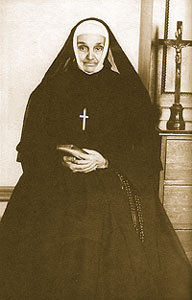
Today the Church in Canada celebrates the Optional Memorial of Blessed Marie-Anne Blondin (1809-1890), the foundress of the Congregation of the Sisters of Saint Anne. Her work established universal education, so that there was a standard for both boys and girls, and men and women could teach both. She suffered greatly from persecution from the order's chaplain and from within the order, but remained humble and dedicated to God's work, instead of pushing back to be prominent in leadership. She died of natural causes at the age of 81 and was beatified on April 29, 2001 by Pope St. John Paul II.
Meditation for Saturday of the Second Week of Easter
The Spirit of Faith
1. "Except I shall see in His hands the print of the nails, and put my finger into the place of the nails, and put my hand into His side, I will not believe." Thomas must see to believe. The Lord deals with this weakness in His disciple with a condescension that is striking. Nevertheless He does not fail to admonish him, "Because thou hast seen Me, Thomas, thou hast believed; blessed are they that have not seen and have believed" (Gospel).
2. Thomas is the representative of that vast throng of men who refuse to accept the testimony of the gospel or of the Church. They accept nothing but that which they can see with their own eyes and touch with their own hands. Thomas is also typical of all those who, though they accept the testimony of the gospel and of the Church, yet in practical life never rise above a purely natural level in their thinking and in their outlook on life. They recite the Creed with the Church, but they lack the spirit of faith. Many Christians and many Catholics have such an attitude. They reason, judge, speak, and act in exactly the same manner as the world about them thinks and acts. Practically speaking, they have no higher ideal than any other man of the world. They are satisfied with health, prosperity, a livelihood, an interesting occupation, and amusing pastimes. When they encounter anything unpleasant or when they suffer hardships, they look about for a scapegoat, disclaiming all personal responsibility, and exhaust all the means at hand to escape from that which is hard or unpleasant. There is nothing supernatural in their point of view or in their manner of acting.
The majority of Christians and of Catholics who subscribe fervently to the creed of the Church, allow themselves to be governed by worldly considerations, by the opinion of their superiors, or by the claims of their worldly occupations, or the needs of their human career. Their actions are governed by human respect; they are swayed by any emotion; and they are covered with a mantle of self-love and pride. Even those consecrated to God and living behind the walls of the cloister are often ruled by purely natural motives far more than they themselves suspect. More than they are aware of it, their actions are governed by self-love in its manifold forms, rather than by motives of faith and the love of God. They live lives that are far from being supernatural. They do not live, as they should, by faith, with their gaze fixed on Christ, on God, and on His holy will. For this reason they experience so much unrest, so much uncertainty, such instability, weakness, and emptiness in their spiritual life. "Blessed are they that have not seen and have believed."
"Know also this, that in the last days shall come dangerous times. Men shall be lovers of themselves, covetous, haughty, proud, blasphemers, disobedient to parents, ungrateful, wicked, without affection, without peace, slanderers, incontinent, unmerciful, without kindness, traitors, stubborn, puffed up, and lovers of pleasure more than of God; having an appearance indeed of godliness, but denying the power thereof" (II Tim 3:1-5). We are tempted to believe that the evil times described here by St. Paul have already arrived. Even in the very strongholds of piety, many pious and spiritual persons have become worldly and exert themselves only in the search for pleasure. They measure life in terms of the senses. Theirs is a piety which is little more than a continuous interplay of sensations and emotions. Such piety naturally shrinks from difficulties, exertions, and self-sacrifice. It occupies itself with spiritual things, even with prayer and the sacraments, only as a means of satisfying its emotional needs. The soul is thus deprived of the benefits it should reap from these exercises. The reward of such effort is merely a desolate spiritual dryness and an enduring emptiness "One encounters scarcely a single person," says St.John of the Cross, "who escapes this tyranny of the senses."
Such souls barely scratch the surface of life; superficiality rules their life of prayer, their work, and their fulfillment of the duties of their state of life. They cannot rise to God, for they are bound to earth by fetters of superficiality. They can never look into the depths, because their attention is always distracted by trivialities. They are warped and become such slaves of minor details that their condition is often ridiculous. They are cast about from side to side, and become continually weaker. They multiply their prayers, increase their efforts and their spiritual exercises; but all this serves merely to dissipate their strength and squander their energy. They have "an appearance indeed of godliness, but deny the power thereof." Such miserable, unfruitful souls have built their spiritual edifice on feelings and emotions rather than on the spirit and the firm foundation of faith. Since they live without having fixed their gaze on God and His love, since they neglect His providence and His will, there is no depth to their piety, no strength or security or stability in their souls. "Blessed are they that have not seen and have believed."
"This is the victory which overcometh the world, our faith" (Epistle). The spirit of faith makes us consider everything we encounter in the light of God and His divine providence. It makes us accept everything as coming from His eternal solicitude and by His divine appointment. Faith gives us enlightenment, solidity, understanding, and peace. "Blessed are they that . . . have believed."
That new life which we received at Easter (that is, when we were baptized), we should strive to increase daily through the celebration of Mass and the devout reception of Holy Communion. We may enrich our spiritual life further by holy reading and the practice of other spiritual exercises. Even when we have done these things, we shall yet remain far from our goal, which is to live entirely by faith. Only when we have reached that goal will we be able to truly celebrate "the paschal solemnity" (Collect).
—Benedict Baur, OSB, The Light of the World, Vol. 2.
Bl. Marie-Anne Blondin
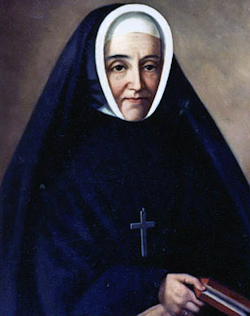 Esther Blondin was born on April 18, 1809 to a Catholic farm family in a rural community in Quebec, Canada. Her mother taught her to worship at the Eucharist and recognize Divine Providence. Her father taught her to have a strong faith and to be patient in times of suffering.
As a young woman, Esther worked as a domestic in her village to help her family. Drawn to vowed religious life, she joined the Congregation of the Sisters of Notre Dame. Illiterate, she learned to read and to write at age 22 as she went about the work of the Sisters. Ill health forced her to give up her dream of becoming a Sister of the Congregation of Notre Dame. After a time of rest, she was Esther became a teacher and then the principal of the school. Later she would train young teachers who taught in small country schools.
Healthy and mature, in 1850, Esther, with permission from the local Bishop, founded the Congregation of the Sisters of St. Anne and became the first Mother Superior, taking the name Marie-Anne.
In the following years, the congregation grew and expanded throughout Canada and the US New England states. And while the Congregation attracted more women seeking vowed religious life, the Foundress faced internal discord with the new chaplain assigned by the Church to oversee the group. She wrote, “As for me, my Lord, I bless Divine Providence a thousand times for the maternal care she shows me in making me walk the way of tribulations and crosses.” (Vatican document)
The foundress was deposed and relegated to the position of laundress, a position she accepted in order to minimize friction and distractions, helping to ensure the further development of the congregation. As is the way when one has trust in Divine Providence, Sister Marie-Anne was now able to personally teach the novices as they worked alongside of her.
One novice, surprised to learn that this simple woman was the foundress of the Sisters of St. Anne asked her why she, the foundress, was doing laundry. Her response:
“The deeper a tree sinks its roots into the soil, the greater its chances of growing, branching out, and bearing fruit.”
She also taught through her life and actions that “There is more happiness in forgiving than in revenge.”
On her deathbed, Sister Marie-Anne said to her sisters, “May Holy Eucharist and perfect abandonment to God’s will be your heaven on earth”. She went home to her “Good God” on January 2, 1890.
Sister Marie-Anne’s example of humility, obedience, forgiveness, and non-violence continue to speak to us today. We continue her mission to those whom God has put in our path, regardless of where the path is located.
In 2001, she was beatified by Pope St. John Paul II.
—Taken from Sisters of St. Anne
Highlights and Things to Do:
- Read more about Blessed Marie-Anne:
- Find out more about the Sisters of St. Anne which she founded.
- Listen to the CatholicSaints.info podcast about Bl. Marie-Anne.
- Read a short History of Her Cause