Easter: April 15th
Wednesday of the Second Week of Easter
Other Commemorations: St. Paternus, Bishop (RM)
MASS READINGS
April 15, 2026 (Readings on USCCB website)
PROPERS [Show]
COLLECT PRAYER
Wednesday of the Second Week of Easter: As we recall year by year the mysteries by which through the restoration of its original dignity, human nature has received the hope of rising again, we earnestly beseech your mercy, Lord, that what we celebrate in faith we may possess in unending love. Through our Lord Jesus Christ, your Son, who lives and reigns with you in the unity of the Holy Spirit, God, for ever and ever.
Recipes (3)
Activities (3)
Prayers (3)
Library (0)
Blog & Podcasts (0)
The Roman Martyrology commemorates St. Paternus (482-586), Bishop. He first joined the monks of Ansion and later became a hermit near Coutances. Eventually he was consecrated bishop of Avranches, Normandy, France.
Meditation for Wednesday of the Second Week of Easter
God so loved the world that he gave his only son, that whoever believes in him should not perish but have eternal life.
With these words of the Gospel of the Mass we are shown how the Passion and Death of Jesus Christ is the supreme manifestation of God’s love for men. He took the initiative in love, surrendering for us him whom He loves most, in whom He is well pleased—his own Son. Our faith is a revelation of his goodness, of the mercy, of the love of God for us. God is love (cf. 1 John 4:16), that is to say, love which is diffusive and is lavish: and everything is summarized in this great truth which explains everything and illuminates everything. It is necessary to see the history of Christ in this light. ‘He loved me’, writes St. Paul and each one of us can and should repeat the same to himself: ‘He loved me and sacrificed Himself for me’ (Gal 2:20). (Pope St. Paul IV, Homily on the Feast of Corpus Christi,13 Jun 1975).
The love of God for us reaches its climax in the Sacrifice of Calvary. God held back Abraham’s arm when he was on the point of sacrificing his only son, but He did not hold back the arm of any of those who were nailing His Only-Begotten Son to the Cross. Therefore St. Paul exclaims, filled with hope: He who did not spare his own Son…will he not give us all things with him? (Rom 8:32).
The self-giving of Christ constitutes a pressing call for correspondence with that love: love is repaid with love. Man was created in the image and likeness of God. And God is Love. Therefore the heart of man is made for love and the more he loves the more he becomes identified with God; only when he loves can he become happy. And God wishes us to be happy, here on earth too. Man cannot live without love.
Personal holiness is not centered in the fight against sin but in love for Christ, who shows Himself to us as being truly human, fully aware of everything about us. The love of God for men and of men for God is a love of mutual friendship. And one of the specific characteristics of friendship is relationship. In order to love Our Lord it is necessary to know Him, to speak to Him. We get to know Him by meditating on His life in the Holy Gospels. In them He shows Himself to us as being endearingly human and very close to our life. We meet Him in prayer and in the Sacraments, especially in the Blessed Eucharist.
Meditation on the Most Sacred Humanity of Our Lord—especially when we read the Gospel and when we consider the Mysteries of the Rosary—constantly nourishes our love of God and constitutes a living teaching as to how we have to sanctify our day. In his hidden life, Jesus wished to descend to the most common things of human existence, to the daily life of a manual worker to supports a family. And so we see him during almost the whole of His life working day after day, caring for his tools in the small workshop, dealing simply and in a friendly way with the neighbors who came to ask Him to make a table for them or a rafter for a new house, caring for his Mother with great affection. That is how He fulfilled the will of his Father God during those thirty years. When we look at his life, we learn to sanctify our own work, our family, our friendships. Everything that is truly human can be holy, can be a channel for our love of God, because Our Lord on assuming our human nature, sanctified it.
—Francis Fernandez, In Conversation with God, Daily Meditations Volume Two: Lent-Holy Week-Eastertide
St. Paternus
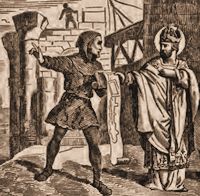 Saint Paternus of Avranches, also known as Paternus of Scissy, Foix, Padarn, Pair, Patier, and Paterno, was born around the year 482 in Poitiers, France. He was the son of Patranus, and from an early age, he felt a deep calling to pursue a life dedicated to God. Following the monastic path, Paternus became a monk at Ansion, France. There, he devoted himself to a life of prayer, study, and contemplation. His spirituality and wisdom quickly became well-known, and he gained a reputation as a holy and humble monk.
After spending a substantial amount of time at the monastery, Paternus felt a strong desire to embrace a life of solitude and hermitage. He left Ansion and settled near Coutances, France, where he embarked on a life of deep reflection and asceticism. His days were spent in prayer, fasting, and engaging in rigorous penance. Paternus's reputation as a wise and holy hermit spread through the region, and many sought his counsel and guidance. People from all walks of life would come to him, seeking spiritual advice, consolation, and blessings. His humble and compassionate manner touched the lives of countless individuals, bringing hope and healing to those in need.
Due to his exemplary spirituality and leadership qualities, Paternus was eventually appointed as the Bishop of Avranches, France. He assumed his episcopal duties with great humility and fervor, striving to guide his flock towards spiritual growth and holiness. As a bishop, he worked tirelessly to educate the faithful and promote the teachings of the Catholic Church. Throughout his episcopal ministry, Paternus remained deeply committed to his personal spiritual practices. He continued to spend much of his time in prayer, studying Scripture, and leading a life of asceticism. His own holiness served as an inspiration to those around him, motivating others to deepen their relationship with God and live lives of virtue.
Saint Paternus lived a long and fruitful life, passing away around the year 568 of natural causes.
Although specific details about his patronage are not available, his profound spiritual wisdom and the impact he had on the lives of others make him a spiritual example to Christians, especially those seeking guidance and inspiration in their own journey towards sanctity. While not much is known about the physical representations of Saint Paternus, such as icons or statues, his memory and legacy endure through the preservation of his spiritual teachings and the admiration of those who have been influenced by his holy life.
Saint Paternus of Avranches was canonized by the Catholic Church before the formal process of canonization was established. He belongs to the period of Pre-Congregation saints. His feast days are celebrated on 15 April, though on some calendars, it is also observed on 16 April. Additionally, some calendars commemorate his feast on 23 September. Saint Paternus of Avranches remains a beloved figure in the Catholic tradition, a shining example of humility, holiness, and dedication to God. His life serves as an inspiration for all Christians striving to deepen their faith and cultivate a profound union with the divine. He is often confused in legends with St. Paternus of Wales.
—Excerpted from Saint for a Minute
Highlights and Things to Do:
- Read more about St. Paternus: