Easter: April 23rd
Thursday of the Third Week of Easter; Opt. Mem. of St. George, Martyr; Opt. Mem. of St. Adalbert, Bishop and Martyr
MASS READINGS
April 23, 2026 (Readings on USCCB website)
PROPERS [Show]
COLLECT PRAYER
Thursday of the Third Week of Easter: Almighty ever-living God, let us feel your compassion more readily during these days when, by your gift, we have known it more fully, so that those you have freed from the darkness of error may cling more firmly to the teachings of your truth. Through our Lord Jesus Christ, your Son, who lives and reigns with you in the unity of the Holy Spirit, God, for ever and ever.
Optional Memorial of St. George: Extolling your might, O Lord, we humbly implore you, that, as Saint George imitated the Passion of the Lord, so he may lend us ready help in our weakness. Through our Lord Jesus Christ, your Son, who lives and reigns with you in the unity of the Holy Spirit, God, for ever and ever.
Optional Memorial of St. Adalbert: O God, who bestowed the crown of martyrdom on the Bishop Saint Adalbert, as he burned with zeal for souls, grant, we pray, by his prayers, that the obedience of the block may never fail the shepherds, nor the care of the shepherds be ever lacking to the flock. Through our Lord Jesus Christ, your Son, who lives and reigns with you in the unity of the Holy Spirit, God, for ever and ever.
Recipes (2)
Activities (3)
Prayers (5)
Library (1)
Blog & Podcasts (0)
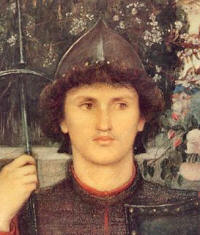
The Universal Church celebrates the Optional Memorial of St. George, Martyr (d. 304), although England celebrates St. George with a Solemnity. Little is known of him except that he was a soldier and martyr. Veneration of St. George comes from the east, probably from Palestine where he was held in high honor as a martyr. Regarded as the patron of Christian armies, he is venerated under this title by the Latins as well as by the Greeks. He is included as one of the Fourteen Holy Helpers.
The Optional Memorial of St. Adalbert, Archbishop (957-997) is a recent addition to the USA liturgical calendar. St. Adalbert was ordained the Bishop of Prague in 983. During his episcopate he encouraged the evangelization of the Magyars. Having founded the monastery of Brevnov, he was forced into exile by the nobility of Prague. He tirelessly preached the Gospel in Poland, Hungary, Russia, and Prussia, where he was martyred at the age of 41.
Meditation for Thursday in the Third Week of Easter
Redemption
1. "Alleluia. The Lord hath sent redemption to His people, alleluia." The Mass of the third Sunday after Easter is built on this theme; it is permeated by the spirit of gladness. "Shout with joy to God, all the earth, alleluia. Sing ye a psalm to His name, alleluia" (Introit). Easter, the resurrection of the Lord is our awakening to a new life of grace. It brings us the promise that we shall one day awaken to a life of glory. "How terrible are Thy works, O Lord!" (Introit.) "Praise the Lord, O my soul. In my life I will praise the Lord" (Offertory).
2. "The Lord hath sent redemption to His people." This deliverance is first of all from the tyranny of the flesh. "Dearly beloved, I beseech you, as strangers and pilgrims, to refrain yourselves from carnal desires, which war against the soul." "Therefore, brethren, we are debtors, not to the flesh to live according to the flesh, for if you live according to the flesh, you shall die; but if by the spirit you mortify the deeds of the flesh, you shall live... The wisdom of the flesh is the enemy of God, for it is not subject to the law of God; neither can it be. And they who are in the flesh cannot please God" (Rom. 8:12 f., 7 f.). Through the holy sacraments of baptism, penance, and the Eucharist, the Lord has made it possible for us to "refrain from carnal desires." Mary and Joseph are shining examples of unsullied purity and perfect chastity and virginity; they were perfectly detached from all inordinate worldly desires. They overcame the unruly tendencies toward pride, impatience, anger, envy, self-love and self-seeking. Their lives were pure and devoted to the love of God and of Christ. Their one concern in life was to do the will of God and what was pleasing to Him. They were victorious over the desires and the movements of the flesh. They were truly redeemed."The Lord hath sent redemption to His people." God has given us also the power to overcome our lower sensual nature, our passions and our evil inclinations. We are redeemed. Though by ourselves we are weak and helpless, we are yet able to overcome our evil inclinations and to conquer in the struggle for purity and holiness. "I can do all things in Him who strengtheneth me" (Phil. 4:13). Ah, had we but the deep living faith so evident in the liturgy! "The Lord hath sent redemption to His people, alleluia."
"Have your conversation good among the gentiles." That is the admonition given by St. Peter in the Epistle. In truth, "you are the light of the world" (Matt. 5:14). "For you were heretofore darkness, but now light in the Lord. Walk, then, as children of the light (Eph. 5:8). "So let your light shine before men that they may see your good works and glorify your Father, who is in heaven" (Matt. 5:16); that is, may they learn to know God and Christ and be led to them. A holy mission indeed! "For so is the will of God, that by doing well you may put to silence the ignorance of foolish men." The Epistle further commands us explicitly to obey our legitimate rulers "Be ye subject, therefore, to every human creature for God's sake." Christian freedom does not release us from the authority of the state or the Church, or from the obligations of our state of life. Furthermore, this Epistle admonishes us to honor everyone and to practice fraternal charity: "Honor all men; love the brotherhood; fear God; honor the king." Finally we are commanded to be subject to authority, whether that authority treat us justly or unjustly: "Servants, be subject to your masters with all fear, not only to the good and gentle but also to the forward. For this is thankworthy." How diligently Joseph and Mary followed such a life of perfect submission! They feared God, prayed, rendered perfect obedience externally and internally to legitimate authority, were humbly subject to all men, often under the most trying circumstances Such a life of submission is the fruit of Easter, the fruit of baptism, of the Eucharist, and of the grace we received through our resurrection with Christ. Why should not this life be possible to me? "The Lord hath sent redemption to His people."
3. "The Lord hath sent redemption to His people." Therefore "shout with joy to God, all the earth, alleluia; sing ye a psalm to His name, alleluia, alleluia" (Introit). Though man is weak and helpless, the Christian can become mighty. He has only to learn the secret of his strength and his greatness, which lie in the light, the grace, the power, the new life, which result from his incorporation in the risen Christ. We know that we have been redeemed, that we are living branches united to the vine and growing by virtue of this union with Christ in His Church. I am not an isolated branch, torn from the vine and choked to death by enveloping thorns; I am a living branch of a great, living organism which shoots its roots deep into the earth, and whose limbs reach upward until they touch the very throne of God. I am a member of that great community which comprises all the strong, pure, noble souls in whom Christ lives, and who share His strength, His spirit, and His life. Indeed, "The Lord hath sent redemption to His people."
How I should rejoice, thank God, and trust in Him! How I should pray and strive to conquer the tyranny of carnal lusts by becoming strong, holy, and perfect before God and men!
—Benedict Baur, OSB, The Light of the World, Vol. 2
St. George
St. George is venerated by the Eastern Church among her "great martyrs" and "standard-bearers." He belonged to the Roman army, was arrested and, probably, beheaded under Diocletian, c. 304. He is the patron of England, since 800. St. George is one of the "Fourteen Holy Helpers."
Many legends are attached to Saint George, the most famous is in The Golden Legend with the dragon. There was a dragon that lived in a lake near Silena, Libya. Not even armies could defeat this creature, and he terrorized flocks and the people. St. George was passing through and upon hearing about a princess was about to be eaten, he went to battle against the serpent, and killed it with one blow with his lance. Then with his great preaching, George converted the people. He distributed his reward to the poor, then left the area.
Patronage: against herpes; against leprosy; against the plague; against skin diseases; against skin rashes; against syphilis; lepers; agricultural workers; archers; armourers; arms manufacturers; boxers; butchers; castle chapels; cavalry in general; French and Italian cavalry; chivalry; equestrians; farmers; field hands; field workers; fighters; halberdiers; horsemen; horses; husbandmen; knights; pugilists; riders; saddle makers; saddlers; sheep; shepherds; soldiers; wrestlers
See CatholicSaints.info for listing of locations and organizations for patronage.
Symbols and Representation: Armor; buckler; dragon
Highlights and Things to Do:
- Read more about St. George:
- Christian Iconography has some beautiful images of St. George.
- See the Statue of St. George on St. Peter's Basilica Colonnade.
- This article from Historic UK gives information on St. George, the growth and influence of legends about him in England and his place in English history.
- Learn more about St. George and scouting.
- See Catholic Cuisine for food ideas for St. George.
- Read more about the Fourteen Holy Helpers.
Saint Adalbert
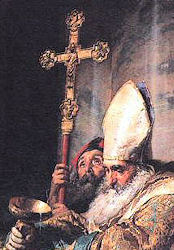 St. Adalbert while still under thirty became bishop of Prague, but the pastoral and political difficulties were such that in 990 he withdrew in desperation to Rome. Pope John XV sent him back to his diocese, where he founded the great abbey of Brevnov; but again he met with opposition to his ministry from the nobility, and again he retired to Rome. At length it became apparent that there was no hope of his working unmolested in Prague, and he was allowed to turn his attention to the heathen Prussians of Pomerania. But here he had no more success. He and his fellow missionaries nevertheless persevered in their mission, and were eventually murdered, perhaps near Konigsberg. Despite the disappointments of his career, St Adalbert of Prague seems to have had considerable influence. He was a friend of the Emperor Otto III, encouraged the evangelization of the Magyars, and inspired St Boniface of Querfurt; his cultus was widespread in central Europe. He in his turn was influenced by the ideals of the great monastery of Cluny.
Patronage: Bohemia; Czech Republic; Northern Slavs; Poland; Prussia; archdiocese of Esztergom-Budapest, Hungary; archdiocese of Gniezno, Poland; archdiocese of Prague, Czech Republic; Cormons, Italy; city of Prague, Czech Republic
Symbols and Representation: holding a two-headed cross, two lances, and a club; holding a lance with a club at the lower end; pierced by three lances and beheaded; baptizing Saint Stephen of Hungary; chains at his feet; angels carrying him to heaven; stabbed with a lance; a globe of fire hovering over his tomb
Highlights and Things to Do:
- Read this homily by John Paul II from the Catholic Culture Library about St. Adalbert.
- Read more about St. Adalbert:
- If you are interested in heraldry you may view several images here.
- Saints in Rome details about St. Adalbert's relics in St. Vitus Cathedral in Prague.
- Read about the mystery of St. Adalbert's resting place.